AI SEO for online shops: what Search Console data can tell you that SEO tools can't
A keyword tool estimates demand across the market. Search Console shows where your own shop is already appearing. Good SEO decisions need that distinction.

An SEO tool says a keyword gets thousands of searches. An AI writer produces a page about it. Three months later, your shop has another article and very little idea whether it helped.
There is a more useful starting point: the searches for which your own pages already appear, the pages Google chooses and the changes you can realistically make.
Search Console does not replace every SEO tool. It gives you a different kind of evidence. That difference matters when the next task is improving a shop rather than filling a publishing calendar.
Market demand and your visibility are different measurements
A third-party keyword tool can help estimate demand, investigate competitors and discover topics where your site has no visibility. Search Console reports interactions with your property in Google's results: impressions, clicks, click-through rate and position, with useful dimensions and filters.
If a category already appears for a relevant buying query, you have something concrete to inspect. Does the page answer that intent? Are the right products in stock? Does the search result make a truthful, useful promise?
Google's Search Analytics API1 supports analysis by dimensions such as query, page, country and device. Its row limits mean an export is not an exhaustive record of every search. Treat the data as evidence with boundaries, not a magical transcript of Google.
Look for a mismatch you can explain
Suppose a category selling waterproof work jackets receives impressions for “waterproof hi vis jacket”, but the text barely mentions waterproof ratings and the relevant products are buried. That is a hypothesis worth checking against the actual range.
The fix might be better product ordering, clearer specifications, an appropriate category page or a more accurate title. It might also be “we don't stock what this person wants”. No amount of elegant AI copy changes the waterproof rating of a jacket.
Compare queries and pages together. One query appearing against several URLs may suggest an unclear page relationship, but it is not automatic proof of harmful cannibalisation. Check intent, canonical URLs and which page should serve the shopper before consolidating anything.
A small CTR example, with the maths visible
Here is a worked example using invented numbers, not a CommerceGears customer result. With 10,000 impressions, a 1.4% CTR gives 140 clicks. At 2.1%, the same impression count gives 210 clicks: 70 more.
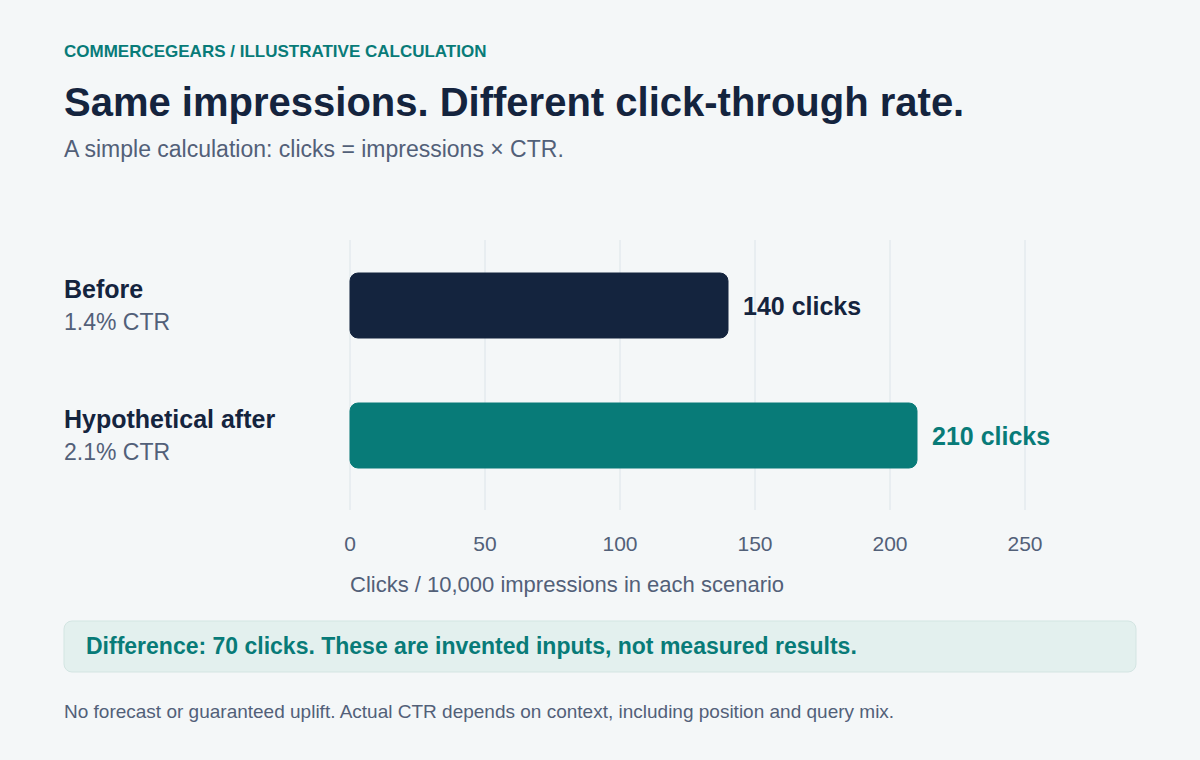
That arithmetic can help size a hypothesis. It does not prove a title edit will produce the higher CTR. Position, device, country, query mix, competitors and search-result features all influence the result. Compare like with like as far as the data allows.
| Example input | Before | Hypothetical after |
|---|---|---|
| Impressions | 10,000 | 10,000 |
| CTR | 1.4% | 2.1% |
| Clicks | 140 | 210 |
Use your own historical context rather than an industry curve that promises every position-five result should receive the same click rate.
Some query data is anonymised for privacy. Google also documents table truncation and differences between property-level and page-level aggregation. Its performance dimensions guide2 explains these limits and canonical attribution.
So a visible query table need not sum neatly to the chart total. Do not “repair” that difference by inventing missing queries. Record your filters, search type, date window and aggregation. A report should let another person reproduce the comparison, or at least understand why they cannot.
Separate brand and non-brand demand where practical. A campaign that makes more people search for your shop's name can lift organic clicks without proving that the category rewrite improved generic visibility.
What AI SEO Advisor does with that evidence
AI SEO Advisor brings Search Console history into Magento, maps performance to pages and records applied SEO processes on the charts. It can draft meta titles and descriptions for review. You decide what to accept and apply; previous values are retained for reverting supported changes.
GA4 is optional. Search Console alone supports keywords, pages, opportunities, processes and impact analysis. Connecting GA4 adds landing-page sessions, engagement, purchases and revenue context. If you do not connect it, do not present a Search Console click increase as measured sales growth.
The optional AI drafting also needs your configured provider and budget. Data analysis and a sensible manual edit are still useful without asking a model to write anything. Sometimes the best SEO change is deleting an inaccurate sentence.
AI SEO Advisor Pro extends the workflow with reviewed page-text edits, value-ranked opportunities, forecasts and other analysis. Estimates are decision aids, not guaranteed profit. SEO Suite addresses technical work such as metadata, structured data, canonical rules and redirects. They solve related but different parts of the problem.
Give each change a reason and a review date
Choose one page or a coherent small group. Write down the problem, the proposed edit and the searches it is intended to help. Check facts against the product data. Apply the approved change, record the date and allow a meaningful measurement window.
Compare the result with the rest of the site and relevant seasonal patterns. Several simultaneous edits, a stockout or a major promotion can muddy the interpretation. Our SEO change-tracking guide explains why the change record belongs beside the chart.
You will sometimes reach “too little data” or “no clear change”. Keep those outcomes. A useful AI SEO tool helps you make and assess better decisions; it does not need to turn every edit into a victory story.
Sources
- Search Analytics API, checked 2 November 2026. ↩
- performance dimensions guide, checked 2 November 2026. ↩
From our shop
Related Products
-
AI SEO Advisor
Your Google Search Console and GA4 history kept in Magento for good, a dated marker for every SEO change on the keyword charts, and AI drafts for meta titles and descriptions that you review, apply and revert.
- Magento 2.4.7 – 2.4.9
- Hyvä
- Luma
- Version v3.12.0
$399
-
AI SEO Advisor Pro
Add page-text edits, profit-ranked opportunities with forecasts, learnings from your own results, searches you do not sell and country and device data per keyword to CommerceGears AI SEO Advisor.
- Magento 2.4.7 – 2.4.9
- Hyvä
- Luma
- Version v1.10.0
From$699
-
SEO Suite
Technical SEO for Magento 2 in one module: JSON-LD structured data, meta templates, canonical and robots rules, hreflang, Open Graph, a redirect manager with 404 log, XML sitemap extras and an SEO audit, for Luma and Hyvä.
- Magento 2.4.6 – 2.4.9
- Hyvä
- Luma
- Version v2.0.5
$199


