The EU withdrawal button: what online shops must show and where
A returns policy link and a withdrawal function do different jobs. Here is how to turn the 2026 requirement into a usable customer journey.

“We have a returns page” sounds reassuring until you try to use it.
The page explains the policy, links to a PDF, tells you to email support and asks you to wait. Somewhere in there, a customer is simply trying to say: “I want to withdraw from this purchase.”
The EU withdrawal button requirement addresses that online step. It deserves its own implementation check, even if your shop already handles returns well.
What changed in June 2026?
Directive (EU) 2023/26731 added Article 11a to the Consumer Rights Directive. National measures apply from 19 June 2026. For covered distance contracts concluded through an online interface, consumers must also be able to exercise an existing withdrawal right through an online function.
The function must be prominent, easily accessible and continuously available throughout the withdrawal period. Its label must clearly communicate withdrawal. A second, clearly labelled confirmation function submits the statement. The trader then acknowledges receipt on a durable medium, including its content and submission date and time, without undue delay.
Those are the core EU requirements. Your country's implementing law, the contracts you sell and the applicable exceptions determine the detailed obligations. The new interface does not create a withdrawal right for every product or replace other valid ways of exercising one. Germany's government describes its implementation in force from 19 June 20262.
A useful flow has two clear actions
Imagine a guest customer who bought a lamp. They should be able to find the function, identify the contract, provide or confirm their details and see what they are about to submit. The final action should be unmistakable.
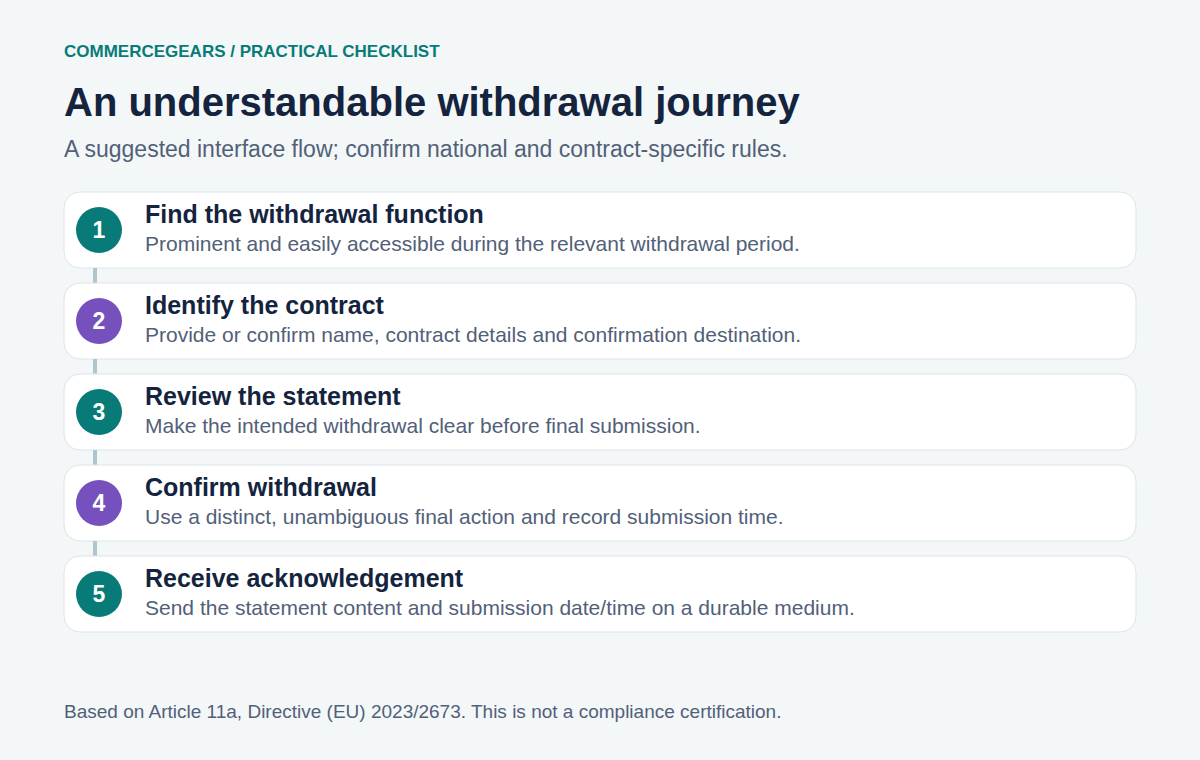
For the first action, the directive uses “withdraw from contract here” or an unambiguous equivalent. For the final action, it uses “confirm withdrawal” or an equivalent. A vague “Continue” button makes people guess. This is not a good moment for creative button copy.
The interface needs the consumer's name, details identifying the contract and the electronic means for sending confirmation. Keep additional fields proportionate. Asking for a reason may be useful feedback, but do not turn an optional answer into a barrier to submitting the withdrawal.
The EU text does not prescribe one universal page layout. It prescribes accessibility and prominence. Treat placement as a journey to test, rather than a belief that adding one footer link settles the matter.
A practical design might provide a clearly named sitewide entry point and a contextual link in order details. Check the mobile menu, footer, confirmation email links and help pages together. The route should still make sense to someone who did not create an account.
Do not put guest buyers through account registration just to reach a purchase they made as guests. Choose a proportionate way to identify the relevant order and protect personal data. Avoid exposing order details through an enumerable public identifier.
Withdrawal, RMA and refunds are different events
| Event | What it records |
|---|---|
| Withdrawal statement | The consumer communicates a decision to withdraw |
| Returns/RMA process | Your team handles return authorisation, parcels, inspection and status |
| Credit memo and refund | The accounting and payment consequences are processed |
A customer may exercise a withdrawal right before a parcel is physically returned. An internal RMA approval step should not rewrite the original submission timestamp or imply that the legal statement is effective only if an administrator likes it.
Likewise, the acknowledgement should confirm receipt of the statement, not falsely announce that a refund has already reached the customer's bank. Explain the next practical steps separately. Our Magento returns guide covers the operational side.
A Magento acceptance test worth keeping
Test a guest order, a registered order and an eligible order close to the end of its withdrawal period. Include a small phone screen and keyboard navigation. Record what happens when email delivery fails or the customer double-clicks the final button.
Your acceptance checklist should cover:
- A discoverable entry point during the relevant period.
- Clear contract identification and understandable localised labels.
- A distinct final confirmation step.
- A stored statement with a reliable submission timestamp.
- A prompt acknowledgement containing the required details.
- An operational queue your team can reconcile with returns and refunds.
Keep the acknowledgement and delivery status available to the support team. A green success message in the browser is little comfort if the email vanished into a configuration problem.
Which CommerceGears modules are relevant?
Returns & RMA supports the returns workflow. SMTP helps with transactional email delivery and diagnostics. Omnibus: Lowest Price & Price History, including GPSR addresses separate price-history and product-safety information requirements.
These connections do not mean the current Omnibus/GPSR module supplies a compliant withdrawal function. The published feature set reviewed for this article does not establish that capability. Check an explicit withdrawal implementation against the requirements; do not buy a price-history extension assuming it covers every EU consumer rule.
If you search for the German “Widerrufsbutton”, also distinguish withdrawal from the separate rules for terminating certain continuing contracts. Similar-looking buttons can serve different legal purposes. Give the interface, stored evidence and support workflow one focused review together. That is much more useful than discovering the distinction in a complaint.
Sources
- Directive (EU) 2023/2673, checked 2 November 2026. ↩
- implementation in force from 19 June 2026, checked 2 November 2026. ↩
From our shop
Related Products
-
Returns & RMA
Customers and guests request returns from their orders on Luma and Hyvä, and your team approves, receives and refunds them in the Magento admin, with every step logged and emailed.
- Magento 2.4.6 – 2.4.9
- Hyvä
- Luma
- Version v2.0.4
$189
-
Omnibus: Lowest Price & Price History (incl. GPSR)
Show the lowest price of the last 30 days before every reduction (EU Omnibus rule), from a price history the module records itself, with a Price History log and an Active Reductions check in your Magento admin. GPSR product safety information is also included.
- Magento 2.4.6 – 2.4.9
- Hyvä
- Luma
- Version v2.3.1
$213
-
SMTP
Send every Magento email through Google Workspace, Microsoft 365, Amazon SES or any SMTP service, with OAuth 2.0, an email log, automatic retries and plain-language diagnostics.
- Magento 2.4.6 – 2.4.9
- Hyvä
- Luma
- Version v1.0.1
Free