Factur-X for Magento 2: France's e-invoicing reform and what your store has to send
Since 1 September 2026 every French business must be able to receive e-invoices, and the duty to issue them reaches small companies in September 2027. What the reform asks for, where the plateforme agréée fits, and how to get a valid Factur-X out of a Magento invoice.

The message comes from a customer's comptabilité fournisseurs: "Merci de nous transmettre vos factures via votre plateforme agréée. Nous ne traitons plus les factures PDF reçues par e-mail." Your Magento store has been sending the same invoice PDF for years. It has your company name and VAT number on it, the lines, the totals. It does not have the buyer's SIREN, it does not say whether you sold goods or services, and it is not a structured file that any platform could read.
This post is for Magento 2 and Adobe Commerce stores that invoice French businesses. It covers what the French reform requires and when, the role of the plateformes agréées, what Factur-X is, which new details your invoices must carry, and how to produce the files from Magento. It is written by the team that makes the E-Invoicing: France module mentioned further down, so weigh that part accordingly. It is not tax advice; your expert-comptable has the final word on your situation.
What changed on 1 September 2026
Since 1 September 2026, every company in France must be able to receive electronic invoices. Large companies and intermediate-sized companies (ETI) must also issue them from that date; small and medium-sized companies (PME) and micro-enterprises issue them from 1 September 20271. To do this, a company chooses a plateforme agréée, an approved platform that issues, receives and transmits e-invoices and certain data to the tax administration1.
Alongside invoicing there is e-reporting: the transmission of transaction data that does not travel as a domestic B2B e-invoice. That covers sales to consumers (B2C), international B2B transactions and payment data2. E-reporting follows the same calendar as issuing3.
You may still see the older name, plateforme de dématérialisation partenaire (PDP), in articles written before the reform started. The Portail public de facturation (PPF) run by the state was refocused on two jobs: the directory (annuaire) that routes invoices and shows, for each company, which plateforme agréée manages its data, and a hub that passes invoicing and transaction data to the tax authority2. It is not the place where your shop sends its invoices; your plateforme agréée is.
What you must do by when
| Date | Who | What |
|---|---|---|
| Since 1 September 2026 | Every company | Be able to receive e-invoices, through a plateforme agréée you have chosen12 |
| Since 1 September 2026 | Large companies and ETI | Issue e-invoices for domestic B2B sales; e-reporting13 |
| 1 September 2027 | PME and micro-enterprises | Issue e-invoices for domestic B2B sales; e-reporting13 |
Which group your company falls into depends on staff numbers, turnover and balance sheet over consecutive financial years. Work it out with your accountant rather than from a blog post.
Factur-X, and the other two formats
The reform does not prescribe a single file. Factur-X is one of the three formats every platform has to accept in France, under the AFNOR standard XP Z12-0124. It is a Franco-German standard for a hybrid e-invoice: a PDF a person can read, with the structured invoice data in UN/CEFACT CII XML inside it. Factur-X and the German ZUGFeRD are technically the same standard4. The other two formats are pure XML, UBL and CII, with no readable page.
Factur-X comes in profiles that carry more or less data: MINIMUM, BASIC WL, BASIC, EN 16931 and EXTENDED4. The EN 16931 profile holds every data point defined in the European standard, and it is the sensible default for a shop: your customer can open the PDF like any other invoice, and their platform reads the XML.
On top of EN 16931, the French reform adds its own business rules, usually referred to as BR-FR, published by the FNFE-MPE as schematrons. A file can be valid Factur-X and still fail them, for example when the seller's SIREN is missing.
The new details on every invoice
The reform brings four new mandatory mentions on invoices, introduced on the same calendar as e-invoicing5:
- the customer's SIREN, when the customer is a business;
- the delivery address of the goods, when it differs from the customer's address;
- the nature of what is invoiced: supply of goods, services, or both;
- "Option pour le paiement de la taxe d'après les débits", if you have opted to pay VAT on that basis.
These sit next to the mentions that were already required between businesses: your SIREN, legal form and share capital for a company, the late payment penalty rate, the fixed 40 € recovery charge for late payment, and the terms of any early payment discount, with "Escompte pour paiement anticipé : néant" when there is none5.
For a Magento store the first one is the awkward one. Magento's checkout asks for a company name and, if you switch it on, a VAT number. It has no SIREN field.
How Magento handles this out of the box
It does not. Magento Open Source and Adobe Commerce create invoices and credit memos and e-mail a PDF. There is no Factur-X, no SIREN, no nature of the transaction, no check against EN 16931 or the French rules, and no connection to a plateforme agréée. You could rebuild each invoice by hand in your platform's portal. For a few French business orders a year that is reasonable; for a steady trade, it is not.
Step by step: Factur-X from Magento
This is the route with our E-Invoicing: France module for Magento 2.4.7 to 2.4.9. The details come from its user guide6.
- Install
commercegears/module-e-invoicing-frwith Composer. It brings the free E-Invoicing Core module, which holds the queue, the admin grid, validation, the checkout fields and the customer downloads. Magento's cron must run: documents are created by cron every five minutes. - Switch it on under Stores > Configuration > CommerceGears > E-Invoicing > General.
- Fill in Seller. Legal name, VAT ID, address in France, contact details, IBAN and BIC, and your SIREN or SIRET as Company Registration Number. Without a SIREN, a Factur-X is stopped with rule BR-FR-10 before anything is created. Put legal form, share capital and RCS registration in Additional Legal Information; it is printed at the foot of every page.
- Check the French rules under E-Invoicing: France. Billing Framework (cadre de facturation) on Automatic uses B1 for physical products only, S1 for virtual or downloadable products only and M1 for both. The three notes (recovery costs, late payment penalties, early payment discount) come with standard French wording; replace it with the wording of your own terms of sale. An empty note stops the file with BR-FR-05.
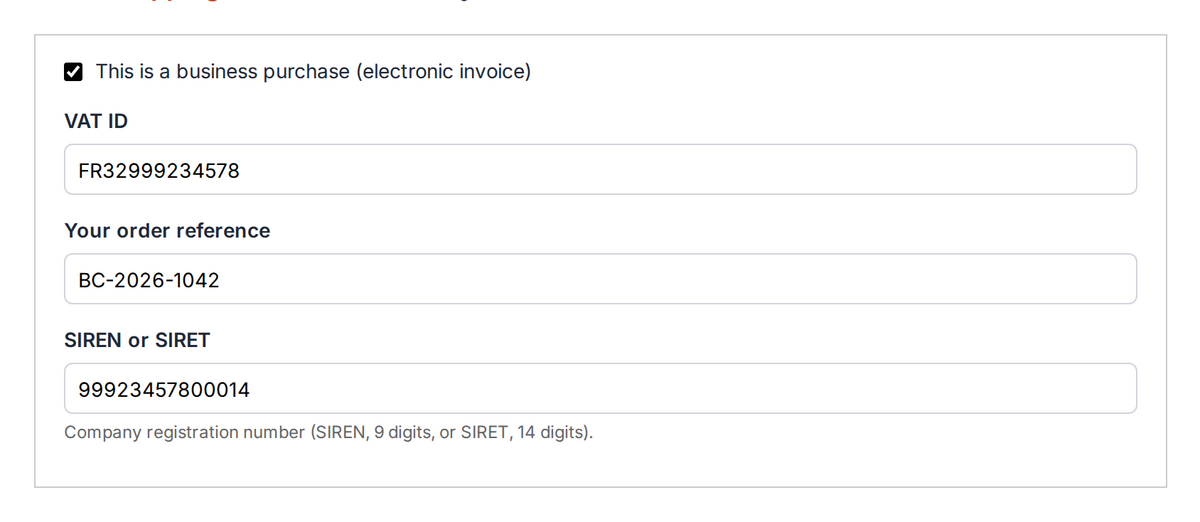
- Look at the checkout. At the payment step, French buyers tick "This is a business purchase (electronic invoice)" and enter their VAT ID, an order reference and their SIREN or SIRET, checked with its check digit as they type. Your team can correct it on the order page.
- Invoice as usual. Within five minutes the Factur-X appears under CommerceGears > E-Invoicing > E-Invoices, checked against the EN 16931 rules, the XML schema, Magento's totals, the SIREN check digits and the module's French checks.
- Upload to your plateforme agréée. Download documents one by one, or select many and use Download Files (ZIP).
The visible PDF is a French invoice ("Facture", or "Avoir" for a credit note) drawn from the same data as the XML, so the page and the data cannot disagree. Labels are French with small English sub-labels. It prints your SIREN, SIRET, VAT number and legal details, the buyer's SIREN or SIRET, the delivery address when it differs, the type of transaction, VAT per rate, payment terms and the three notes. If you prefer Magento's own invoice PDF, there is a setting for that.
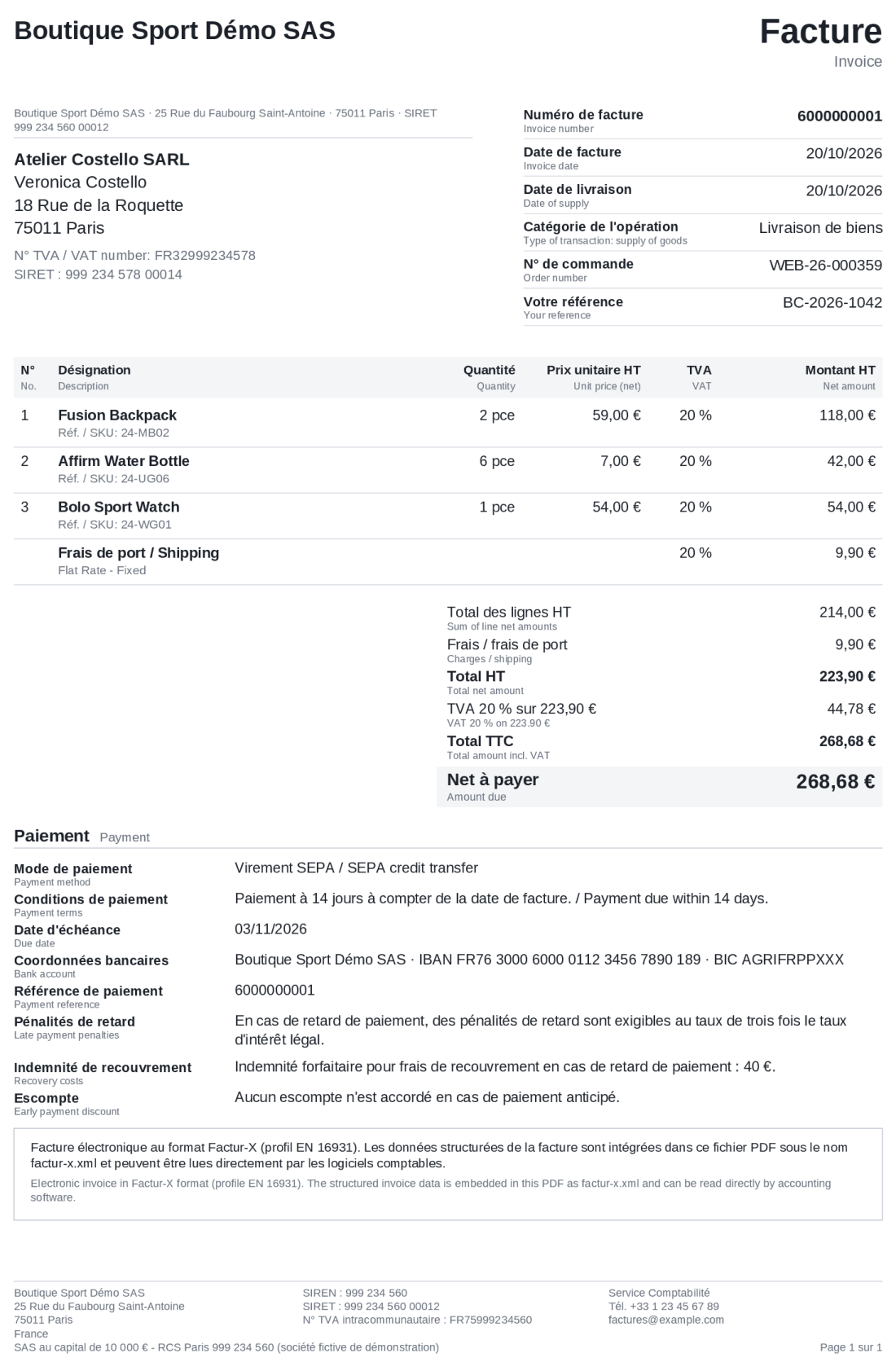
What we checked: the demo store's invoice and credit note passed the official French CTC rules (FNFE-MPE BR-FR schematrons 1.4.0), the Factur-X EN 16931 rules and the EN 16931 CII rules without errors or warnings, and the PDFs passed veraPDF as PDF/A-3B6. Please check sample files with your own platform before your first live invoice.
What the module does not do: connect to a plateforme agréée's API (you upload the files), e-reporting of B2C or international sales, deposit, already-paid or self-billing invoice frameworks, or a layout in languages other than French with English sub-labels. Invoices in a currency other than euro get a warning from the French rules, because the VAT amount in euro is not added.
Checklist
- Choose a plateforme agréée for receiving your own purchase invoices, if you have not already.
- Work out with your accountant whether you issue from September 2026 or September 2027.
- List who you invoice: French businesses, consumers, customers abroad. Only the first group gets e-invoices; the others fall under e-reporting.
- Ask French business buyers for their SIREN or SIRET at checkout.
- Make sure your SIREN, legal form, share capital and RCS registration are in your seller settings.
- Replace the default payment notes with the wording of your terms of sale.
- Ask your platform which formats it takes and test sample files with it.
- Correct mistakes with a credit note and a new invoice, never by editing a sent file.
Frequently asked questions
Is a PDF invoice by e-mail still allowed?
Between French businesses, only until your company's issuing date: September 2026 for large companies and ETI, September 2027 for PME and micro-enterprises1. Your customers must already be able to receive e-invoices, so some may ask for them before your own date.
Do I need e-invoices for sales to consumers?
No. B2C sales are not e-invoiced; their data is part of e-reporting2.
Can I send invoices to the PPF directly?
The public portal now acts as the directory and the data hub2. Invoices go through a plateforme agréée.
Is Factur-X the same as ZUGFeRD?
Technically, yes4. If you also sell to Germany, our post on XRechnung and ZUGFeRD covers the German rules.
The E-Invoicing: France product page has a demo checkout with the SIREN field and an example Factur-X to download.
Sources
- Service Public Entreprendre, "Electronic invoicing is effective since September 1st, 2026!", published 2 September 2026, https://entreprendre.service-public.gouv.fr/actualites/A18953?lang=en, checked 26 October 2026. ↩1 ↩2 ↩3 ↩4 ↩5 ↩6
- Agence pour l'Informatique Financière de l'État (AIFE), "Facturation électronique interentreprises" (role of the PPF, plateformes agréées, calendar, e-reporting), https://aife.economie.gouv.fr/nos-applications/facturation-electronique-b2b/, checked 26 October 2026. ↩1 ↩2 ↩3 ↩4 ↩5
- Service Public Entreprendre, "Electronic invoicing: it's coming soon!" (e-reporting on the same calendar), updated 27 February 2026, https://entreprendre.service-public.gouv.fr/actualites/A15683?lang=en, checked 26 October 2026. ↩1 ↩2 ↩3
- FNFE-MPE, "Factur-X" (hybrid PDF with CII XML, same standard as ZUGFeRD, profiles, one of the three formats under AFNOR XP Z12-012), https://fnfe-mpe.org/factur-x/, checked 26 October 2026. ↩1 ↩2 ↩3 ↩4
- Service Public Entreprendre, "Mentions obligatoires sur une facture", verified 11 August 2026, https://entreprendre.service-public.gouv.fr/vosdroits/F31808, checked 26 October 2026. ↩1 ↩2
- CommerceGears, E-Invoicing: France user guide and FAQ, sections 3 to 7, https://commercegears.com/user-guides/magento-2-extensions/e-invoicing-france-factur-x/, checked 26 October 2026. ↩1 ↩2
From our shop
Related Products
-
E-invoicing: France (Factur-X)
French e-invoices from your Magento invoices: Factur-X PDFs with the EN 16931 XML inside, carrying the data the French reform rules require, ready to upload to your plateforme agréée (PA).
- Magento 2.4.7 – 2.4.9
- Hyvä
- Luma
- Version v2.4.0
$199
-
E-invoicing: Germany (XRechnung, ZUGFeRD)
German e-invoices from your Magento invoices: ZUGFeRD PDFs in a clear German invoice layout for businesses, XRechnung 3.0 for public bodies with a Leitweg-ID, checked before they are sent and ready to download in My Account.
- Magento 2.4.7 – 2.4.9
- Hyvä
- Luma
- Version v2.2.2
$199
-
Order Tools
Your own order, invoice, shipment and credit memo numbers, useful extra columns in the order grid, a test order flag and carefully guarded order deletion with an audit log.
- Magento 2.4.6 – 2.4.9
- Hyvä
- Luma
- Version v2.0.2
Free