B2B on Magento Open Source without Adobe Commerce: what you need
A trade customer asking for 200 units does not necessarily need an enterprise purchasing portal. Start with the buying process you need to support.

A trade customer wants 200 units, a delivery estimate and a better price. Your shop offers one unit, “Add to cart” and a hopeful contact form.
That gap is a B2B requirement. It does not automatically mean you need every feature in an enterprise procurement platform.
Magento Open Source can support a useful B2B webshop with the right extensions and integrations. The sensible starting point is a buying process written in plain language, before the module shopping begins.
What Open Source does not include
Adobe Commerce B2B is a separate commercial feature set. Its documented capabilities include company support, shared catalogues, quote negotiation, quick order and requisition lists. Adobe's B2B configuration guide1 makes clear that these settings require the B2B extension on a Commerce project.
An Open Source store with customer groups and a quote extension is not the same product. It may still be exactly what a smaller wholesaler needs. Make the comparison against actual requirements: one buyer per business is a different problem from several company divisions with approval limits and shared credit.
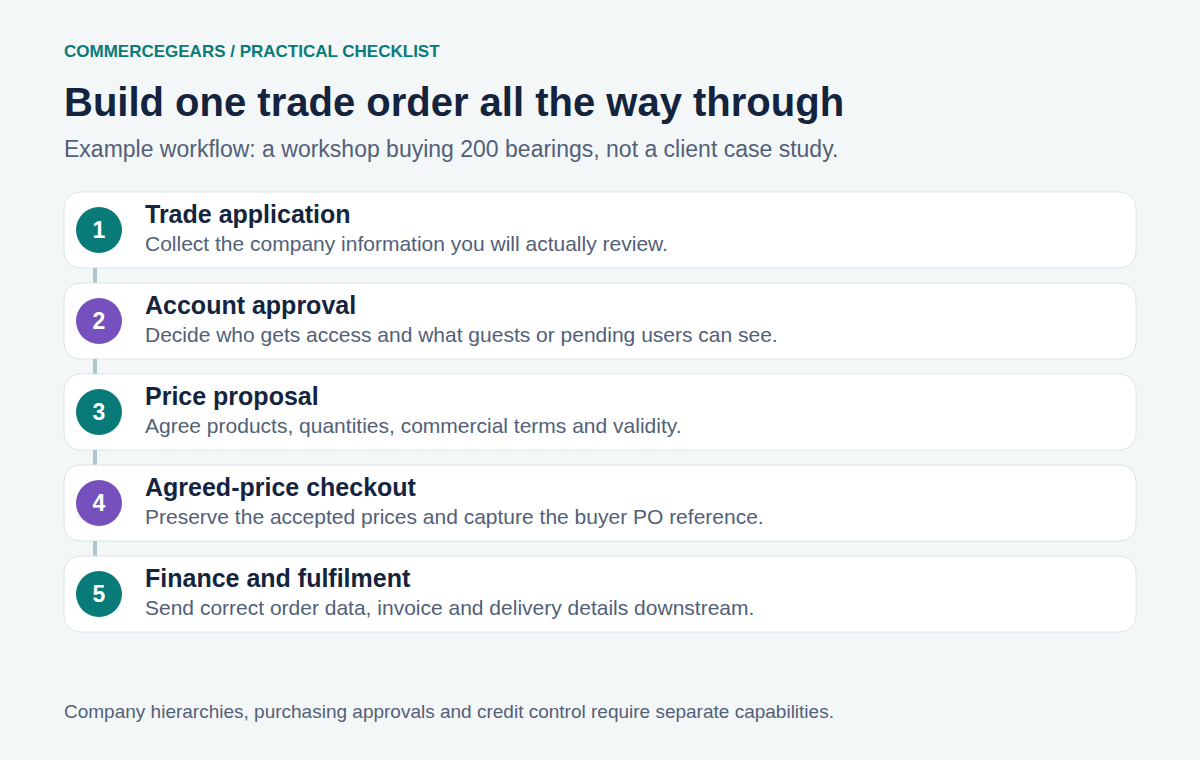
Here is a hypothetical example, not a client case study. A workshop applies for a trade account, gives its company details, requests a price for 200 bearings, accepts the proposal, enters a PO reference and receives an invoice that finance can reconcile.
That gives you a concrete workflow to build and test. It also reveals what is missing: who approves the account, who can change the quoted price and where the PO reference appears after checkout?
Start with account access and company data
Customer Approval lets you hold new accounts for review and supports login blocking while approval is pending. That is useful when you need to check trade applications before granting access.
But approval alone does not make a public catalogue trade-only. Check guest browsing, pricing, search, direct product URLs and API access against the restrictions you intend. Our customer approval guide explains this distinction.
Collect only the company data you will use. Customer Attributes can add account and address fields such as company type or a VAT number. Decide what is required, which team validates it and what changes need another review. A text field containing a VAT number does not prove it has been validated or establish the correct tax treatment.
For mixed B2B/B2C shops, keep the consumer journey simple. Ask business-specific questions when they become relevant rather than making a retail customer invent a company name to buy a mug.
Quotes must survive the trip to checkout
The useful part of a quote system is not the form. It is the handover from the agreed proposal to the order.
Request a Quote lets buyers request a price from a product page or basket, and lets the merchant respond with a proposal. Accepted prices go into the cart with the agreed-price handling described by the module. It also includes quick order and hidden-price options; configure those for your business rather than treating every option as mandatory.
Test quantity changes, product options, tax, shipping and other discounts. Decide what should happen when the buyer tries to add another ten units or use a retail coupon. The order should reflect the agreement, not whichever price rule happened to run last.
We cover those details in from quote to order. Include the salesperson and finance team in the test; they often spot a missing condition faster than a frontend review does.
PO numbers are data, not purchase approvals
Checkout Fields can collect a purchase order number, cost centre or invoice reference. Check that the value reaches the order, relevant emails, invoice and any export you use.
That field does not create a company purchasing hierarchy, enforce an employee's spending authority or provide a credit limit. Those require separate capabilities. Likewise, an offline payment option labelled “Pay on account” does not perform credit control by itself.
| Requirement | A focused starting point | Extra question |
|---|---|---|
| Review trade registrations | Account approval | What can pending and guest users still access? |
| Negotiate a bulk order | Quote workflow | Are agreed prices preserved through checkout? |
| Capture a buyer's PO reference | Order field | Does finance receive the value? |
| Multi-user company purchasing | A company-account solution | Who can approve, order and see company data? |
| Credit and payment terms | Finance and ERP integration | Who owns limits, exposure and overdue accounts? |
Decide whether Magento or your ERP owns invoices, payment terms, tax decisions and customer balances. A manual handover may be acceptable at low volume if it is explicit and reconciled. It becomes expensive when everyone believes someone else's system is doing it automatically.
For Belgian in-scope B2B transactions, include Peppol e-invoicing requirements in that design. Sending an ordinary PDF is not the whole process. Check other countries separately.
Repeat buyers also care about finding SKUs quickly, knowing availability and reproducing a previous order. Test discontinued items, minimum quantities and changed prices. A convenient reorder should not resurrect an expired commercial agreement.
When Adobe Commerce B2B deserves a closer look
If you need extensive company structures, buyer permissions, shared catalogues, approval chains and integrated purchasing controls, compare Commerce B2B against assembling and maintaining several solutions. Include licence, implementation, support and operational costs on both sides.
Open Source B2B is a valid choice when its workflow matches your business. It is not automatically the cheapest choice at every level of complexity. Build the workshop's order from application to reconciliation, test it and price the gaps. That will tell you more than a feature list with sixty green ticks.
Sources
- B2B configuration guide, checked 2 November 2026. ↩
From our shop
Related Products
-
Request a Quote
Shoppers ask for a price from the product page or the cart, you reply with a proposal from the admin, and the agreed prices go into their cart, locked. Quick order and hidden prices included.
- Magento 2.4.6 – 2.4.9
- Hyvä
- Luma
- Version v2.0.6
$229
-
Customer Approval
New customer accounts wait for your approval before they can sign in, with rules per website, an approval queue and emails to your team and your customers.
- Magento 2.4.6 – 2.4.9
- Hyvä
- Luma
- Version v2.1.1
Free
-
Customer Attributes
Add your own fields to Magento customer accounts and addresses, such as a company type, VAT number or address type, with rules per store and customer group, conditional fields and values on every order.
- Magento 2.4.7 – 2.4.9
- Hyvä
- Luma
- Version v1.2.0
$199
-
Checkout Fields
Add your own fields to the Magento checkout without code, such as a delivery date, PO number, order comment or a dropdown, and find the answers on the order, in the order grid, in emails and on the invoice PDF.
- Magento 2.4.6 – 2.4.9
- Hyvä
- Luma
- Version v2.1.1
$119